
- 05/10/2026
- Dr. Raviram
- 0 Comments
- Fistula
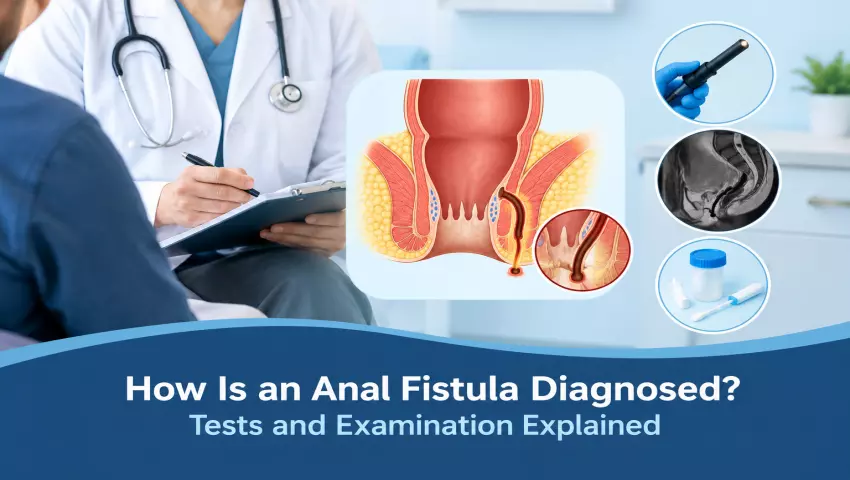
How Is an Anal Fistula Diagnosed? Tests and Examination Explained
Noticed a small opening near your anus that keeps discharging pus or blood, no matter how much you clean it? You are not alone, and this is actually one of the most common reasons people search for Fistula Treatment in Thrissur. The condition is called an anal fistula, and while the symptoms can feel embarrassing to talk about, getting an accurate anal fistula diagnosis early is what actually makes recovery smooth and quick.
So how is an anal fistula diagnosed exactly, and how do doctors diagnose anal fistula cases with confidence? What tests do doctors run, and what should you expect during an examination? Dr. Raviram S., a proctologist based in Thrissur with over 16 years of experience treating anorectal conditions, walks us through the complete diagnostic process below, so you know exactly what to expect before you even step into a clinic.
Symptoms That Lead to an Anal Fistula Diagnosis:
Most patients come in with a fairly consistent set of anal fistula symptoms. These typically include:
- Persistent pain around the anus, especially while sitting or passing stool
- Continuous or intermittent discharge (pus, blood, or a foul-smelling fluid) from a small opening near the anus
- Skin irritation or itching around the affected area due to constant discharge
- Swelling or a tender lump close to the anus
- Fever or general fatigue if there’s an active infection
These are usually the early signs of anal fistula, and if you notice even one or two of them persisting for more than a week, it’s worth getting checked rather than waiting it out. Many people ignore these signs thinking it’s just a minor irritation, but untreated fistulas rarely heal on their own.
Medical History and Risk Factor Assessment:
Before any physical check-up, your doctor will ask a set of important questions to understand the background. This step matters because anal fistula causes vary quite a bit from person to person. Your doctor may ask about:
- Any previous anal abscess and fistula episodes
- History of anorectal surgery
- Presence of inflammatory bowel diseases like Crohn’s disease or ulcerative colitis
- Past history of tuberculosis or radiation exposure
- Obstetric injuries in women (especially after difficult deliveries)
This history helps the doctor understand whether the fistula is a simple, isolated case or connected to an underlying chronic condition that also needs attention — and it’s often this conversation that shapes the entire Fistula Treatment in Thrissur plan going forward.
Physical Examination:
Once the history is noted, the actual anal fistula examination process begins. This is usually straightforward and doesn’t take long:
- Visual inspection of the perianal skin to check for external openings, redness, or swelling
- Digital rectal examination (DRE), where the doctor gently feels the anal canal to detect any thickened tract or tenderness
- Identifying the location of the external opening and estimating the direction of the tract using Goodsall’s rule, which helps predict where the internal opening might be
A good Proctologist in Thrissur can often get a fairly accurate idea of the fistula’s path just through this hands-on examination, though imaging is still needed to confirm the details before planning treatment.
Imaging and Diagnostic Tests:
This is where the real anal fistula test process comes in, and it’s usually the part patients are most curious about. Let’s go through each test for anal fistula in detail:
1. Anoscopy or Proctoscopy:
A small, lighted instrument called an anoscope (or proctoscope) is gently inserted into the anal canal. This lets the doctor directly view the lining of the anus and lower rectum, helping identify the internal opening of the fistula, any associated inflammation, or signs of an abscess.
- Quick outpatient procedure, usually done without anaesthesia
- Takes just a few minutes
- Helps locate the internal opening directly
- No special preparation needed beforehand
2. Fistula Probing Test:
Here, a thin, blunt-tipped probe is very gently passed through the external opening of the fistula to trace its path. This fistula probing test helps the doctor understand the direction and depth of the tract.
- Traces the exact course of the fistula tract
- Must be done slowly and carefully by an experienced doctor
- Risk of creating a false passage if done too aggressively
- Often combined with imaging for better accuracy
3. Endoanal or Transrectal Ultrasound:
This is a specialised fistula ultrasound test where a small probe is inserted into the anal canal to get a close-up view of the tract and surrounding muscles.
- Shows how close the tract is to the sphincter muscles
- Sometimes uses hydrogen peroxide injection for clearer visibility (3D peroxide-enhanced ultrasound)
- Painless and done on an outpatient basis
- Useful for planning surgery without damaging continence muscles
4. MRI Pelvis (MRI Fistulogram):
If you’re wondering what MRI fistulogram is, in simple terms, it’s a detailed anal fistula MRI scan of the pelvic region focused entirely on mapping the fistula. It’s considered the gold standard for fistula in ano diagnosis, especially in complex or recurrent cases.
- Shows the full length and branching pattern of the tract
- Detects hidden secondary tracts or infection pockets not visible externally
- Maps the exact relationship between the tract and sphincter muscles
- No injections or probing required
- Scan usually takes 20 to 30 minutes
5. CT Fistulogram:
In this test, a small amount of contrast dye is injected into the external opening of the fistula, and CT images are taken to trace where the dye travels.
- Contrast dye clearly outlines the tract on the scan
- Generally used when MRI isn’t accessible or suitable
- MRI still preferred for most cases due to better soft-tissue detail
6. Examination Under Anaesthesia (EUA):
For complicated, recurrent, or unclear cases, doctors may recommend an EUA. The patient is given anaesthesia, and the doctor performs a detailed assessment in the same sitting.
- Combines physical examination, probing, and sometimes ultrasound
- Done without any discomfort to the patient
- Often combined with actual surgical treatment in the same session
- Useful for complex or recurrent fistulas needing detailed mapping
Together, these tests give the doctor a complete perianal fistula diagnosis, mapping out exactly where the fistula starts, where it ends, and how it relates to the surrounding muscles — which is essential before deciding on the right surgical approach.
Classification of Anal Fistulas:
Once the diagnostic tests are done, fistulas are classified based on how they relate to the sphincter muscles. This classification isn’t just academic; it directly decides which treatment approach will preserve continence while effectively clearing the infection.
Fistulas are also broadly grouped as simple or complex. The difference between simple and complex fistula cases comes down to how many tracts are involved, how deep they go, and how close they are to the sphincter muscles — complex fistulas usually have multiple tracts or involve a larger portion of the sphincter, making them trickier to treat. This is exactly why many complex cases today are managed with the Best Laser Fistula Treatment in Thrissur, which allows more precision with minimal impact on bowel control.
Differential Diagnosis:
Since several conditions in this region present with similar symptoms, doctors also rule out other possibilities during diagnosis. Common comparisons include anal fistula vs hemorrhoids, anal fissures, pilonidal sinus disease, hidradenitis suppurativa, and in rare cases, malignancy. This step ensures the treatment plan targets the actual problem rather than a look-alike condition.
When to See a Doctor?
Knowing when to see a doctor for anal fistula symptoms can save you a lot of discomfort down the line. If you’ve been dealing with recurring discharge, pain, or swelling near the anus for more than a week, it’s best not to self-medicate or delay further.
Consulting an experienced Proctologist in Thrissur early can prevent complications like recurrent abscesses or a more complex tract formation. Depending on the diagnosis, your doctor might recommend anal fistula surgery as part of the overall anal fistula treatment plan, and many patients today prefer the Best Laser Fistula Treatment in Thrissur for its shorter recovery time and minimal discomfort compared to traditional surgery.
Conclusion:
Getting an accurate anal fistula diagnosis doesn’t have to be a confusing or intimidating process. From understanding your symptoms to going through imaging tests like MRI or ultrasound, each step is designed to map the fistula precisely so the anal fistula treatment actually works the first time. If you’re dealing with any of the symptoms discussed above, consulting a specialist like Dr. Raviram S. can make the entire journey — from diagnosis to recovery — far less stressful and a lot more reassuring.
Don’t wait for the discomfort to get worse. Book a consultation with Dr. Raviram S. today and get a clear, accurate diagnosis for your condition — the first step toward lasting relief.
Frequently Asked Questions (FAQ's):
Diagnosis usually starts with a physical examination, including a digital rectal exam, followed by imaging tests like MRI fistulogram or endoanal ultrasound to map the tract accurately. In some cases, anoscopy or CT fistulogram is also used, depending on the complexity of the case.
While some very mild fistulas may not cause immediate issues, most anal fistulas don’t heal on their own and tend to get worse over time — leading to recurrent infections or abscesses. Surgery, including options like laser treatment, is usually needed for a permanent cure.
In the early stages, an anal fistula often appears as a small red or swollen opening near the anus, sometimes with mild discharge. It may look like a small pimple or boil initially, which is why many people mistake it for a minor skin issue.
An anal fistula isn’t usually life-threatening, but if left untreated, it can lead to repeated infections, abscess formation, and in rare long-standing cases, may increase certain health risks. Timely diagnosis and treatment prevent these complications.
In very early or minor cases, doctors may try conservative management, but the majority of anal fistulas require a surgical procedure — such as fistulotomy or laser treatment — for complete and lasting resolution.
No major preparation is usually needed. A physical exam can be done right away, though for MRI or ultrasound-based tests, your doctor may give you specific instructions beforehand, like fasting or an enema in select cases.