
- 09/10/2026
- Dr. Raviram
- 0 Comments
- Fistula
Anal Fistula Surgery Recovery: When Can You Return to Normal Activities?
You have been told you need fistula surgery. Most people are not scared of the operation itself. What keeps them awake is the question that comes after it: “How long before my life is normal again?”
If you are wondering what bhagandar kya hai, it is a small abnormal tunnel between the inside of the anal canal and the skin near the anus. It usually forms after an abscess and does not heal on its own.
Here is something many patients do not hear before surgery. Two people can have the same operation, and one is back at the desk in a week while the other is still uncomfortable after two months. The difference is rarely luck. It depends on a few things that are easy to control once you know them.
In this guide, Dr. Raviram S., a proctologist in Thrissur at Thrissur Piles Clinic, explains the real anal fistula surgery recovery time and what you can do to shorten it. If you are looking for Fistula Treatment in Thrissur, this will help you plan your time off, your work and your family.
Factors That Affect Recovery Time:
The fistula surgery recovery time is different for every patient. These are the main reasons:
- Fistula classification: Doctors group fistulas as simple or complex. Simple ones are shallow and cross very little muscle. Complex ones are deeper, have multiple tracts or pass through more of the sphincter muscle, so they heal slowly.
- Fistulated abscess: If your fistula started as a drained abscess, the area may be more inflamed, and healing can take a little longer.
- Type of surgery: Fistulotomy, seton, LIFT and laser each heal differently. Fistula laser surgery recovery time is generally shorter because the cut is smaller and the sphincter muscle is protected. This is why many patients look for the Best Laser Fistula Treatment in Thrissur.
- Your health: Diabetes, smoking, low immunity and conditions like Crohn’s disease slow down healing.
- Aftercare: Wound hygiene and diet matter more than most people expect.
Anal Fistula Surgery Recovery Timeline:
How long does it take to recover from fistula surgery? For most patients, the fistula operation recovery period looks like this:
- First 2 days: Some soreness and a dressing. Many patients go home the same day or the next morning.
- Week 1: Rest, regular sitz baths and prescribed medicines. Mild bleeding or discharge is normal.
- Weeks 2 to 4: Pain reduces noticeably. Most people resume light routines.
- Weeks 4 to 8: Major healing happens. Complex fistulas may need the full eight weeks or more.
Is fistula surgery painful? There is discomfort, especially during the first few bowel movements, but it is manageable with pain medicines, stool softeners and sitz baths. Most patients say it was less painful than they feared.
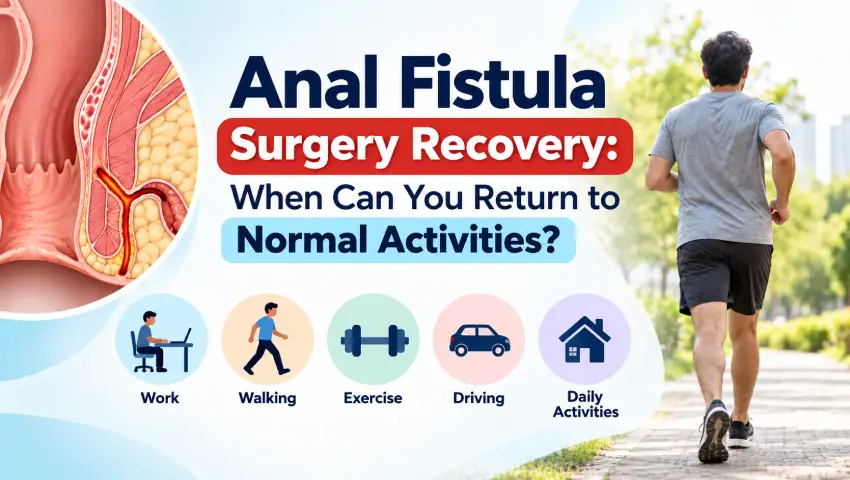
When Can You Return to Normal Activities?
This is the part everyone wants answered. The honest answer is that your body decides the pace, not the calendar. The timelines below are general guidelines for most patients. After laser surgery you can usually be at the faster end of each range. After fistulotomy, seton or flap procedures, expect to stay closer to the longer end. Your surgeon will adjust these based on how your wound looks at follow-up.
1. Work:
Return to work after fistula surgery depends mostly on what your job demands.
- Desk or work-from-home jobs:Most patients return in 5 to 10 days. After laser surgery, some go back in 3 to 5 days. Use a cushion and stand up often.
- Jobs with moderate activity(teaching, shop work, light field work): Around 2 to 3 weeks.
- Physically heavy jobs(construction, factory work, carrying loads): 4 to 6 weeks, sometimes longer for complex fistulas.
If you can, plan a few days of rest at home first. Going back too early is one of the most common reasons for pain and delayed healing.
2. Driving:
You can drive once you have stopped taking strong painkillers and can sit comfortably without pain. For most people this is 1 to 2 weeks. Two-wheeler riding needs more caution because of the vibration and pressure on the area, so wait 3 to 4 weeks. Keep your first few drives short, and use a soft cushion.
Walking and Light Exercise:
Walking is good for you, and you should start early.
- Day 1 to 3: Short, slow walks inside the house.
- Week 1: Gentle 10 to 15 minute walks, two or three times a day.
- Weeks 2 to 3: Longer walks, light stretching and simple breathing exercises.
Walking improves blood flow, helps healing and prevents constipation. Stop if you feel pain or notice more bleeding.
3. Gym, Lifting and Sports:
This is where patients often rush, so be patient.
- Weeks 3 to 4: Light exercises such as slow cycling on a stationary bike (with a cushion), yoga without deep squats or strong pelvic pressure, and light stretching.
- Weeks 6 to 8: Weight training, running and normal gym routines, if your wound has healed well.
- After 8 weeks or more: Heavy lifting, cricket, football, outdoor cycling and other contact or high-impact sports. Complex fistulas may need longer.
Heavy lifting increases pressure in the abdomen and pelvis, and this can disturb the healing wound. Always take your doctor’s go-ahead before restarting intense workouts.
4. Sitting for Long Periods:
Sitting puts direct pressure on the surgical area, so it is usually the most uncomfortable part of recovery.
- Take a break every 30 to 40 minutes. Stand, stretch or walk a little.
- Use a donut or U-shaped cushion for office chairs, car seats and dining chairs.
- Avoid hard surfaces and sitting on the floor for long hours.
- Sit slightly tilted to one side if the wound is on one side.
Most patients find that sitting becomes comfortable in 2 to 4 weeks.
5. Travel:
- Short local trips: Fine after about a week, once you are comfortable sitting.
- Long road or train journeys: Wait 2 to 3 weeks, and plan stops to walk around.
- Flights: Usually fine after 2 to 3 weeks, with an aisle seat and a cushion.
Carry your medicines, a cushion and a change of dressings. Do not skip your sitz baths while travelling. If you are travelling for Fistula Treatment in Thrissur from another city or state, ask your doctor how many days you should stay nearby for your first follow-up.
6. Sexual Activity:
Most doctors suggest waiting 3 to 4 weeks, or until the wound is no longer tender, there is no active discharge and you feel comfortable. After complex fistula surgery, you may need to wait longer. If you are not sure, ask your surgeon. It is a normal question and they will answer it clearly.
7. Bathing and Daily Routine:
Normal showers are fine from the first few days, as long as you gently pat the area dry. Avoid swimming pools and public water bodies until the wound has fully healed, usually 4 to 6 weeks, to reduce infection risk. Squat toilets are usually fine, but avoid long squatting and straining.
Tips for Faster Recovery:
Sitz bath after fistula surgery: This is the single most useful habit.
- Sitz bath benefits: It soothes pain, relaxes the sphincter muscle, keeps the wound clean and improves blood flow for healing.
- How to do a sitz bath: Sit in a tub or basin of warm water for 10 to 15 minutes, 2 to 3 times a day and after every bowel movement. Pat dry gently, do not rub.
- Sitz bath temperature: Comfortably warm, around 37°C to 40°C. Hot water can irritate the wound.
- What to put in a sitz bath: Plain warm water is enough. Add salt or an antiseptic solution only if your doctor suggests it.
- How to do a sitz bath at home: A clean bucket or a sitz bath basin that fits over the toilet seat works well.
Other habits that help:
- Eat fibre-rich food such as oats, fruits, vegetables and dals, and drink 2.5 to 3 litres of water daily.
- Avoid straining on the toilet. Constipation is the biggest enemy of recovery after fistula surgery.
- Do not skip follow-up visits, even if you feel fine.
- Quit smoking. It delays wound healing.
Choosing an experienced surgeon also affects recovery. Many patients find the Best Laser Fistula Treatment in Thrissur gives them less pain and a faster return to routine, as long as the fistula type suits laser treatment.
Warning Signs: When to Call Your Doctor?
Some changes are normal. A little mucus from anus or liquid discharge from anus, light spotting and mild swelling are part of healing, especially in the first 2 to 3 weeks.
Contact your doctor if you notice:
- Severe or increasing pain after the first week
- Fever or chills
- Heavy bleeding
- Foul-smelling pus
- Redness and swelling around the wound
- Difficulty passing urine or stool
If you are in Kerala, a proctologist in Thrissur can examine the wound and tell you quickly whether it is healing the way it should.
Conclusion:
The anal fistula surgery recovery time is not the same for everyone, but it becomes much easier when you know what to expect. Follow your sitz bath routine, eat well, avoid straining and attend your follow-ups. Most patients return to normal life much sooner than they feared.
If you are considering Fistula Treatment in Thrissur, you can consult Dr. Raviram S. at Thrissur Piles Clinic. With 16 years of experience, he will examine your condition and guide you on the right procedure and recovery plan.