
- 29/06/2026
- Dr. Raviram
- 0 Comments
- Piles
Why Some Anal Problems Need MRI Evaluation?
When a doctor recommends an MRI, the first reaction for most patients is worry. They assume it means something very serious. But that is not always the case.
Sometimes, an MRI is simply the most accurate way to understand what is happening inside the body — before any treatment begins. And for certain anal and rectal conditions, skipping this step can lead to months of repeated problems and failed treatments.
At Thrissur Piles Clinic, Dr. Raviram S. — a trusted proctologist in Thrissur — has treated thousands of patients who came to him after prior treatments failed. In most of those cases, the root cause was the same — the condition was never properly evaluated before treatment was started.
This blog explains why some anal conditions need an MRI, what the scan actually shows, and how it helps in getting the right treatment done — the first time.
What Is an MRI Scan and How Does It Help?
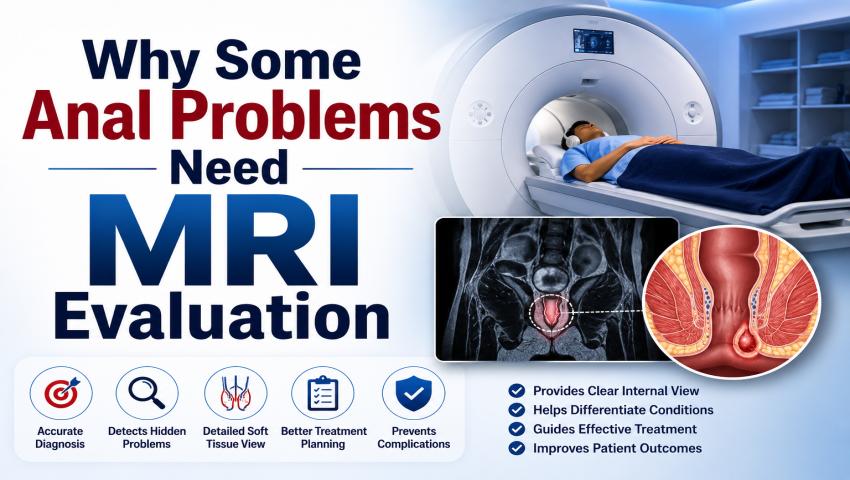
MRI stands for Magnetic Resonance Imaging. It is a scan that uses magnetic fields and radio waves to create clear, detailed images of the soft tissues inside the body. There is no radiation involved. It is completely safe.
What makes MRI especially useful for anal and rectal conditions is its ability to show what is hidden deep inside — tunnels, pockets of infection, muscle involvement, and fluid collections that cannot be seen or felt from the outside. Even an experienced doctor examining a patient closely may not be able to tell the full picture without a scan.
For conditions like anal fistula, pilonidal sinus, and perianal abscess, an MRI gives the surgeon a complete road map before surgery. This makes a very big difference in outcomes.
Why These Problems Look Simple But Are Often Not?
Here is something most patients do not realise.
A condition around the anal area can look very small from the outside — a tiny opening on the skin, a little swelling, some pain or discharge. But underneath, the actual problem may be much larger. There can be multiple hidden tunnels branching in different directions, deep muscle involvement, or a network of pockets filled with infection.
If treatment is started based only on what is visible on the surface, the problem keeps coming back. The patient visits multiple clinics. Medicines are given. Small procedures are done. But nothing works for long.
Dr. Raviram S. has seen this pattern many times in his 16 years of experience as a proctologist in Thrissur. The solution is not just better treatment — it is better diagnosis. MRI makes that possible.
Which Conditions May Require an MRI?
1. Anal Fistula — When the Tunnel Has Multiple Paths:
An anal fistula is a small tunnel that connects the inside of the anal canal to the skin near the anus. It typically forms after an anal abscess that does not heal properly. The most common symptoms are discharge, pain, and sometimes a small opening on the skin near the anus.
The challenge with fistulas is that they are not always straightforward. Some fistulas have multiple branches. Some pass through or around the muscles that control bowel movements. These are called complex fistulas, and they need very careful surgical planning.
If surgery is done without knowing the full path of the fistula, the branches that are missed will cause it to return. Or worse, the muscle fibres controlling continence may be damaged during surgery, which can lead to very serious long-term problems.
An MRI shows the complete anatomy of the fistula — every branch, every turn, how deep it goes, and which muscles are involved. Dr. Raviram S., who has performed over 1,500 fistula surgeries, uses this information to plan each case individually, ensuring the surgery is complete, precise, and safe.
2. Pilonidal Sinus — More Than One Small Hole:
A pilonidal sinus is a small cyst or tunnel near the tailbone, at the top of the buttocks. It is most common in young adults who sit for long hours — students, software professionals, and drivers. It causes pain, swelling, and discharge near the tailbone area.
What looks like one small opening on the skin can actually be a complex network of sinuses underneath. If only the visible part is removed during surgery and the hidden extensions are left behind, the sinus returns within months. This is one of the most common reasons for pilonidal sinus recurrence.
As a pilonidal sinus surgeon in Thrissur with over 800 surgeries performed, Dr. Raviram S. recommends an MRI for complex or recurring cases. With a clear picture of the full extent of the sinus, everything can be removed in one well-planned surgery — without guesswork.
3. Chronic Anal Fissure — When It Just Does Not Heal:
An anal fissure is a small tear in the inner lining of the anal canal. It causes sharp, burning pain during and after passing stools. In most patients, fissures heal with medicines and dietary changes within a few weeks.
But some fissures become chronic — they stay for months and do not improve despite treatment. When this happens, there is usually an underlying reason. It could be very tight anal sphincter muscles, poor blood supply to that area, or even a small abscess developing nearby.
An MRI helps identify exactly why the fissure is not healing. Once the cause is clear, the right treatment plan becomes straightforward. Dr. Raviram S. has treated over 700 fissure cases and always looks for the root cause before recommending surgery.
4. Piles With Unusual or Worrying Symptoms:
Piles — also known as haemorrhoids — are swollen veins inside or around the anal canal. They cause bleeding, itching, swelling, and discomfort. Most pile cases can be diagnosed with a clinical examination and are treated without needing a scan.
However, some patients have symptoms that do not quite fit the usual picture of piles. The bleeding may look different. There may be a constant pressure or heaviness deep inside. The symptoms may not improve with standard treatment.
In these cases, an MRI helps rule out other conditions — such as a deep abscess, rectal prolapse, or something more serious. Getting the right diagnosis is far more important than starting the first treatment that looks reasonable. As a piles specialist in Thrissur, Dr. Raviram S. takes a thorough and careful approach to every case.
5. Perianal Abscess — Finding the Full Extent:
A perianal abscess is a painful collection of pus that forms near the anus. It causes intense throbbing pain and visible swelling. Simple abscesses near the surface can be drained quickly with a minor procedure.
But when an abscess is deep, large, or recurrent, an MRI is very helpful. It shows exactly where the abscess is, how far it extends, whether it has spread to surrounding spaces, and whether a fistula has already started to form. Without this information, draining the abscess may relieve pain temporarily but not solve the underlying problem.
What to Expect During the MRI Scan?
Many patients feel anxious about getting an MRI. The process is actually very simple and completely painless.
You will lie down on a flat surface that slides into the MRI machine. The scan usually takes around 30 to 45 minutes. You will hear a knocking sound from the machine — earplugs or headphones are provided. In most cases, no injections or special preparation is needed beforehand.
After the scan, a radiologist prepares a detailed report. Dr. Raviram S. then carefully studies the report and explains the findings to you in plain, simple language. No medical jargon, no confusion — just a clear conversation about what the scan shows and what the next steps are.
Why Getting the Diagnosis Right Matters More Than Starting Treatment Fast?
At Thrissur Piles Clinic, there is one principle that guides every case — understand the problem completely before treating it.
Many patients who visit the clinic have already been treated elsewhere. Some have had multiple procedures. Some have been on long courses of antibiotics. Yet the problem keeps returning. In most of these cases, the full extent of the condition was never properly evaluated before treatment began.
For anal conditions, incomplete treatment does not just fail to cure. It can make the next surgery more difficult. Scar tissue forms. The anatomy around the area changes. What could have been a straightforward procedure becomes a complex one.
When Dr. Raviram S. recommends an MRI, it is because he wants to be completely certain before deciding on any procedure. That is not extra caution. That is responsible, patient-centred medicine.
About Dr. Raviram S.

15,000 +
Happy Patients

16 +
Years of Experience

4,000 +
successful surgeries

99%
Success Ratio
Dr. Raviram S. is a Gastrointestinal Surgeon and Laser Proctologist based in Thrissur, Kerala, with over 16 years of experience in treating conditions of the colon, rectum, and anal canal.
He is the Founder and Director of Thrissur Piles Clinic, one of the most trusted proctology centres in Kerala. The clinic has treated more than 15,000 patients with a 99% success rate, and Dr. Raviram S. has personally performed over 4,000 advanced proctology surgeries.
His qualifications include:
- MCh in Surgical Gastroenterology — Government Medical College, Thiruvananthapuram (Specialisation in Minimally Invasive GI Surgery)
- MS in General Surgery — Government Medical College, Thiruvananthapuram (Awarded Best Outgoing Student)
- MBBS — Government Medical College, Thrissur
He has been recognised with the Global Healthcare Icon Award at Prime Time 2024 for Healthcare Excellence in Laser Proctology, and the Excellence Award in Laser Proctology at the Global Healthcare and Wellness Awards and Conference held in New Delhi in November 2022.
His research has been published in leading journals including the Journal of Minimal Access Surgery and the Indian Journal of Gastroenterology.
Conclusion:
Ignoring anal problems or opting for quick, temporary fixes can make the condition much worse. As we have seen, complex issues like deep fistulas or deep pilonidal sinuses cannot be understood fully with a simple external checkup. An MRI scan acts as an eye under your skin. It gives your doctor a perfect roadmap to treat the root cause of your pain without any guesswork.
By choosing advanced diagnostic tools like an MRI, you protect your delicate muscles, ensure a highly successful laser surgery, and stop the disease from ever coming back.
If you are suffering from chronic pain, swelling, or bleeding, do not delay your treatment out of fear or embarrassment. Put an end to your suffering today. Click here to book an appointment or visit Dr. Raviram S. at Thrissur Piles Clinic for a proper scientific evaluation, a precise diagnosis, and a permanent, pain-free cure.
Frequently Asked Questions:
Not usually for a simple fissure — it’s diagnosed on exam. MRI is used only if the fissure is chronic or a hidden fistula/abscess is suspected.
It’s a pre-surgery scan that maps a fistula’s exact path and its relation to the sphincter muscles, helping the surgeon plan safely.
It shows the fistula’s type, number of tracts, any abscess, and how close it is to the anal sphincter.
It’s used to closely examine soft tissues between the anus and genitals to diagnose fistulas, abscesses, or tumors.