
- 18/06/2026
- Dr. Raviram
- 0 Comments
- Fissure
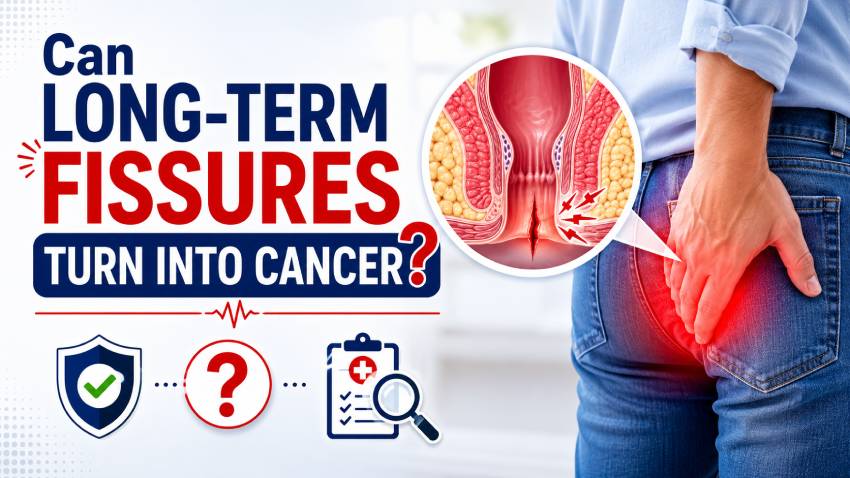
Can Long-Term Fissures Turn Into Cancer?
Many people live with anal fissure pain for months — sometimes even years. They manage the pain with home remedies. They avoid going to a doctor because they feel embarrassed. They hope it will go away on its own.
But one question that keeps coming to their mind is this — can a long-term fissure turn into cancer?
It is a fair and important question. And the honest answer is — a simple anal fissure does not directly become cancer. But ignoring it for a long time is still not safe.
Here is why.
When a fissure stays for too long without proper treatment, it can lead to other complications. And in some cases, what looks like a fissure from the outside may actually be something more serious underneath. That is why every chronic fissure needs proper medical evaluation — not just self-treatment at home.
Dr. Raviram S., a trusted Fissure Specialist in Thrissur with over 16+ years of experience, has treated hundreds of patients who ignored their fissure symptoms for far too long. This blog explains what a chronic fissure really means, whether it can become dangerous, and what you should do about it.
What Is an Anal Fissure?
An anal fissure is a small tear or cut in the thin lining of the anal canal. It is one of the most common conditions that a fissure specialist sees every day.
The main symptoms are:
- Sharp pain during and after passing stools
- Burning sensation that lasts for minutes or hours
- Small amount of bright red blood on tissue paper
- Itching or irritation around the anal area
Most fissures happen because of hard stools, constipation, or straining too much during bowel movements. They can also happen due to diarrhoea, childbirth, or low-fibre diet.
A fresh fissure — called an acute fissure — usually heals within four to six weeks with medicines and diet changes. But when a fissure stays for more than eight weeks, it is called a chronic fissure. This is when patients need to be more careful.
Can a Chronic Fissure Turn Into Cancer?
Let us answer this directly.
A chronic anal fissure, by itself, does not turn into anal cancer. Fissures are not pre-cancerous conditions. They do not transform into cancer the way some other conditions might. But there is an important reason why this question needs a longer answer. Some types of anal cancer or rectal tumours can look and feel very similar to a fissure. A patient may notice bleeding, pain, or a tear-like feeling — and assume it is just a fissure. They treat it at home for months. By the time they visit a doctor, the actual problem has become more serious.
This is the real danger. Not that the fissure itself becomes cancer — but that a cancer can hide behind fissure-like symptoms for a long time.
Conditions like anal carcinoma, Crohn’s disease with anal involvement, or even a rectal polyp can present with symptoms very similar to a fissure. If you are treating yourself for a fissure but the actual problem is something else, you are losing precious time. This is why Dr. Raviram S. always does a proper clinical evaluation before starting treatment. As a fissure specialist in Thrissur with over 700 fissure surgeries performed, he has seen cases where the presenting symptom looked like a simple fissure but the actual diagnosis was something entirely different.
Warning Signs That Need Immediate Attention:
A normal fissure has clear symptoms. But there are certain warning signs that should never be ignored. These may indicate something more serious than a simple fissure.
See a doctor immediately if you notice:
- Bleeding that is more than just a small amount on tissue paper
- Pain that is constant — even when you are not passing stools
- A lump or growth near the anal area
- Fissure symptoms that have not improved at all after 8 to 12 weeks of treatment
- Unexplained weight loss along with anal symptoms
- Mucus or unusual discharge from the anal area
- Symptoms that keep changing or getting worse over time
Any one of these signs means you need a proper medical examination — not more home remedies.
Why Do Some Fissures Not Heal?
This is a question that many patients ask during anal fissure treatment in Thrissur.
When a fissure becomes chronic and simply refuses to heal, there is usually a reason. The most common reasons are:
- High internal anal sphincter tone — The muscle around the anal canal becomes too tight. This reduces blood flow to the area. Without enough blood supply, the tissue cannot heal. This is actually the most common reason for chronic fissures.
- Poor dietary habits — A diet low in fibre causes hard stools. Every bowel movement tears the fissure open again before it can heal.
- Underlying conditions — Conditions like Crohn’s disease, irritable bowel syndrome, or even HIV can cause fissures that behave differently from normal ones. These need very different treatment approaches.
- Previous incomplete treatment — Many patients start treatment, feel a little better, and stop. The fissure partially heals and then breaks open again. Over time, scar tissue forms at the edges. This makes the fissure even harder to heal.
When Dr. Raviram S. evaluates a chronic fissure, he does not just look at the surface. He looks for the underlying cause. This is what makes the difference between treatment that works and treatment that does not.
How Is a Chronic Fissure Properly Treated?
The good news is that chronic anal fissures respond very well to treatment — when the right approach is used.
At Thrissur Piles Clinic, anal fissure treatment in Thrissur is done in a step-by-step way:
- Medical management first Stool softeners, high-fibre diet, plenty of water, and topical ointments are the first line of treatment. These help reduce pain and allow the fissure to start healing.
- Muscle relaxants Topical nitrates or calcium channel blockers are applied to relax the tight internal sphincter muscle. When the muscle relaxes, blood supply improves and the fissure can heal.
- Botulinum toxin injection If medicines do not give enough relief, a small injection of botulinum toxin is given into the sphincter muscle. This temporarily relaxes the muscle and allows the fissure to heal over several weeks.
- Laser surgery (if needed) For fissures that do not respond to any of the above, a minimally invasive laser procedure is the most effective option. Dr. Raviram S. uses advanced laser techniques for fissure surgery. The procedure is quick, nearly painless, and has a very short recovery time. Most patients go home the same day.
The laser approach used at Thrissur Piles Clinic causes minimal damage to surrounding tissue. It relaxes the sphincter precisely, without the risk of incontinence that older surgical methods sometimes carried.
Why Choosing the Right Doctor Matters?
Fissures are one of those conditions where the doctor’s experience makes a very big difference.
A doctor who only does a surface-level examination may miss an underlying condition. A doctor who is too quick to recommend surgery may put a patient through an unnecessary procedure. And a doctor who does not understand the full anatomy of the anal sphincter may cause more harm than good.
Dr. Raviram S. holds an MCh in Surgical Gastroenterology from Government Medical College, Thiruvananthapuram, with a specialisation in Minimally Invasive GI Surgery. He has been recognised with the Global Healthcare Icon Award at Prime Time 2024 for Healthcare Excellence in Laser Proctology and the Excellence Award in Laser Proctology at the Global Healthcare and Wellness Awards and Conference, New Delhi, in November 2022.
At Thrissur Piles Clinic, every patient is given time. The examination is thorough. The diagnosis is clear. And the treatment is explained in simple language before anything is started.
Do Not Delay — Chronic Fissures Need Medical Attention
A fissure that has been troubling you for more than two months is a chronic fissure. It will not go away on its own. The longer you wait, the more scar tissue forms, and the harder it becomes to treat without surgery.
More importantly — if there is any chance that your symptoms are not from a simple fissure, you need a proper diagnosis. The only way to know for sure is to see a doctor.
If you are looking for the right Fissure Treatment in Thrissur, Dr. Raviram S. and the team at Thrissur Piles Clinic are here to help. With 700+ fissure cases treated, 15,000+ happy patients, and a 99% success rate — you are in experienced, caring hands.
Do not let fear or embarrassment stop you from getting the help you need.
Book Your Consultation Today:
If you are tired of the constant pain and want a permanent solution, you can easily book an appointment with Dr. Raviram S., the most trusted Fissure Specialist in Thrissur.
At Thrissur Piles Clinic, we ensure completely private, comfortable, and world-class care for every patient.
To schedule a consultation at our clinic on Collectorate Road, you can call us anytime at 9961001199 or visit our official website at www.thrissurpilesclinic.com. Take a step forward today and choose a healthy, pain-free life!
Email: drraviram12@gmail.com Open: 24 Hours