
- 30/09/2026
- Dr. Raviram
- 0 Comments
- Fissure, Fistula, Piles
Why Accurate Diagnosis Matters in Piles, Fissure and Fistula?
Have you ever been treated for piles, but the pain just wouldn’t go away no matter what you tried? You’re not alone — and there’s often a simple, overlooked reason behind it: a wrong diagnosis. Piles, fissures and fistulas often get lumped together because they cause similar discomfort in the same part of the body, but each one needs its own approach to treatment. Mixing them up, even briefly, can mean weeks or months spent on a treatment that was never going to work in the first place.
According to Dr. Raviram S., a large number of patients walking into clinics for Fistula Treatment in Thrissur were originally treated for piles or fissures — sometimes for months — before the real problem was identified. Getting the diagnosis right, the first time, makes all the difference between quick relief and prolonged suffering.
Why Diagnosis Is the First Step in Patient Safety?
Patient safety isn’t only about avoiding surgical errors or medication mix-ups — one of the most common, preventable safety failures in everyday practice is a wrong or delayed diagnosis. Piles, fissures and fistulas are a textbook example of where this happens — because they look alike, but behave very differently once left untreated.
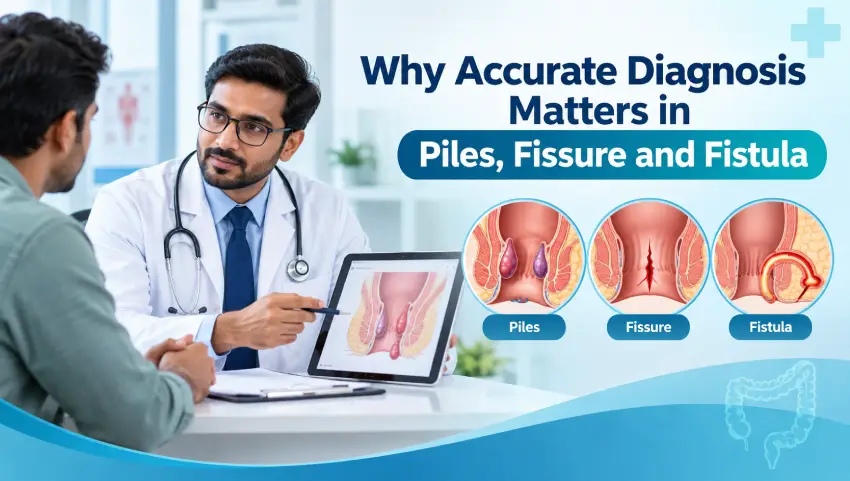
Piles, Fissure and Fistula: Different Conditions, Similar Symptoms
Piles, fissures and fistulas are three separate conditions that share a frustrating trait — overlapping symptoms like pain, bleeding, and irritation. This is exactly why patients, and even doctors without specialised training, end up confusing one for the other. Here’s what sets them apart:
Piles (Hemorrhoids):
- What it is: Swollen blood vessels inside the rectum or anus
- Main symptom: Usually painless bleeding, with a feeling of fullness and itching
- Nature of pain: Mild or absent, unless external and thrombosed
- Severity scale: Graded I to IV depending on how much they protrude
Fissure:
- What it is: A small tear in the lining of the anal canal
- Main symptom: Sharp, burning pain during and after passing stool
- Nature of pain: Intense, short bursts — often the most painful of the three
- Bleeding: Minor, bright red streaks, not heavy
Fistula:
- What it is: An abnormal tunnel connecting the anal canal to the skin
- Main symptom: Pus or discharge, recurring swelling, skin irritation
- Nature of pain: A dull, persistent ache that worsens with sitting
- Cause: Usually a previous, untreated anal abscess or infection
In short: piles bleed without much pain, fissures cause sharp pain with minimal bleeding, and fistulas discharge pus with a constant dull ache — but real-life symptoms don’t always follow this pattern, so self-diagnosis is still risky. Since these conditions need different treatments, accurate diagnosis is essential — creams and diet changes, for instance, cannot close a fistula’s internal tunnel; that needs surgical correction.
Why Diagnosis Gets Confusing?
Bleeding, pain and swelling are common to all three conditions, making self-diagnosis (and even a rushed clinical check) unreliable. A patient bleeding during motion may assume it’s “just piles,” when a fissure or an early-stage fistula could be the real cause. Some overlapping signs that commonly cause confusion:
- Bleeding — seen in piles, fissures, and occasionally fistulas with inflammation
- Pain while sitting — common to fissures, external piles, and surface-level fistulas
- Swelling — can point to piles, a thrombosed vessel, or an early fistula opening
- Itching or irritation — linked to piles, but also to fistula discharge
- Incomplete evacuation — reported in both piles and chronic fissures
Symptoms also evolve over time — an untreated fissure can turn chronic and develop into a fistula tract, while untreated piles may bleed intermittently, making the problem seem “manageable” when it’s actually progressing. This is why a one-time glance or quick assumption is never enough.
Common Causes of Misdiagnosis:
- Self-medication — buying piles creams without consulting a doctor
- Delay in seeking help — embarrassment or fear pushing people to ignore symptoms
- Lack of awareness — not knowing these are three different conditions needing different treatment
- Skipping specialist consultation — a general physician may miss finer diagnostic details that a Proctologist in Thrissur is trained to catch
- Incomplete examination — a rushed consultation without proper visual or instrumental checks
Consequences of Misdiagnosis:
- Wrong treatment that doesn’t address the actual problem
- Prolonged pain and discomfort affecting daily life
- Infections spreading further (especially risky with fistulas)
- Higher chances of recurrence
- Unnecessary or repeated surgeries, adding cost and stress
- Longer recovery time overall
An incorrect diagnosis doesn’t just delay healing — it can turn a simple, treatable condition into a more complicated one.
Case Example: When a Fistula Is Mistaken for Piles?
A patient notices bleeding and discomfort and assumes it’s piles, based on what a friend or the internet suggested. They use piles ointments for weeks — the bleeding eases temporarily, but discharge and swelling continue. It’s only after seeking proper Piles Treatment in Thrissur at a specialised clinic that an examination reveals it was actually an anal fistula all along, needing surgery, not creams. This kind of delay is common, and it usually happens simply because the patient never got a proper anorectal examination in the first place.
Benefits of Accurate Diagnosis:
- Right treatment — medication, minimally invasive procedures, or surgery, whichever fits the condition
- Faster recovery — no time lost on ineffective treatments
- Lower risk — fewer complications, less chance of recurrence
- Cost savings — no repeated consultations or avoidable follow-up surgeries
- Peace of mind — patients understand what’s actually wrong with them
This is patient safety in action — not just avoiding errors, but protecting a patient’s time, money and wellbeing.
Role of Modern Diagnostic Methods:
- Proctoscopy — direct visual examination of the anal canal and lower rectum
- MRI Fistulogram — maps complex fistula tracts before surgery
- Digital rectal examination — a simple, effective first step
- Anoscopy — detects internal piles or fissures early
- Ultrasound-guided evaluation — used for deeper or recurrent fistula tracts
These tools remove the guesswork, letting doctors plan targeted Fissure Treatment in Thrissur or any other treatment based on facts, not assumptions.
Why Specialist Consultation Matters?
A qualified proctologist is trained to spot the subtle differences between piles, fissures and fistulas that a general check-up might miss. At Thrissur Piles Clinic, Dr. Raviram S. and the team focus on thorough examination before recommending any treatment, so patients get the correct diagnosis — not a guess based on symptoms alone.
For complex cases involving pus discharge or recurring infections, timely Fistula Treatment in Thrissur becomes critical, as fistulas rarely resolve on their own. Early, specialist-led diagnosis at this stage can prevent months of unnecessary discomfort.
The Bigger Picture: Right Diagnosis, Right Treatment
The core message here is simple: safe treatment starts with correct diagnosis — not just treating symptoms, but identifying the actual condition first. This holds true especially for anorectal disorders, where similar symptoms can mask very different problems, and getting it wrong costs months of avoidable discomfort. Whether it’s Piles Treatment in Thrissur or care for a fissure or fistula, the starting point is always the same: an accurate diagnosis.
Conclusion – Awareness Is the Biggest Safety Measure
Piles, fissures and fistulas may look alike on the surface, but they are not the same — treating them as if they are can cost patients valuable time, comfort and money. Don’t self-diagnose, don’t delay, and don’t hesitate to consult a specialist. If you’re experiencing persistent symptoms, getting evaluated by a Proctologist in Thrissur could be the one step that finally gets you the right answer — and the right relief.
Don’t let a wrong diagnosis prolong your discomfort. If you’ve been experiencing pain, bleeding, or discharge that just won’t go away, book a consultation with Dr. Raviram S. at Thrissur Piles Clinic today, and get an accurate diagnosis backed by 16 years of specialised experience — because the right treatment always starts with the right diagnosis.